
This is a summary of other people's advice, and it says whose. Every point below comes from a video indexed on Acting Craft, our free searchable library of acting advice on YouTube. Each one links to the video it came from, so you can watch the person say it. We have added nothing of our own except the order.
Before you set anything up
Read the breakdown first, then build the frame. Casting directors each have slightly different preferences for how they want to see a tape, and they are watching dozens a day. Following the process they stated is a form of respect, and it costs nothing. Source.
If a breakdown says casting is completed from self tapes and you are not set up to make one, think before you submit. The note is there for a reason. Source.
The room
Leave space in front of you and behind you. One studio setup runs about five feet between the actor and the back wall, and another four feet to the camera. That distance blurs the background on its own, keeps your shadow off the wall, and leaves room to move sideways or enter a scene without the lens hunting for focus. Source.
Kill the echo before you buy a microphone. Two parallel hard surfaces facing each other turn a room into an echo chamber, and echo is what makes it hard to tell your voice from the reader's. Break it up with a loaded bookshelf, a rug over hard flooring, or record in a closet where the hanging clothes absorb everything. Source.
Keep the background empty. Nothing in frame should compete with your face. Source.
Camera and framing
Landscape, medium close up, armpit to just above the head. Portrait adds black bars and shows less of you. If you are not sure where mid chest is, use your armpit as the reference. Source.
Lens at eye height, tilted very slightly down. The slight downward tilt flatters most faces because of the curve of the lens. A phone flat on a desk that you act down into distorts the proportions of your neck and head. Source.
You do not need any of this to start. One setup in the library is a coat rack from Amazon, an iPhone, a phone tripod, and either sunlight or a white bulb in a cheap floor lamp. White light, not yellow. Source.
Light and sound
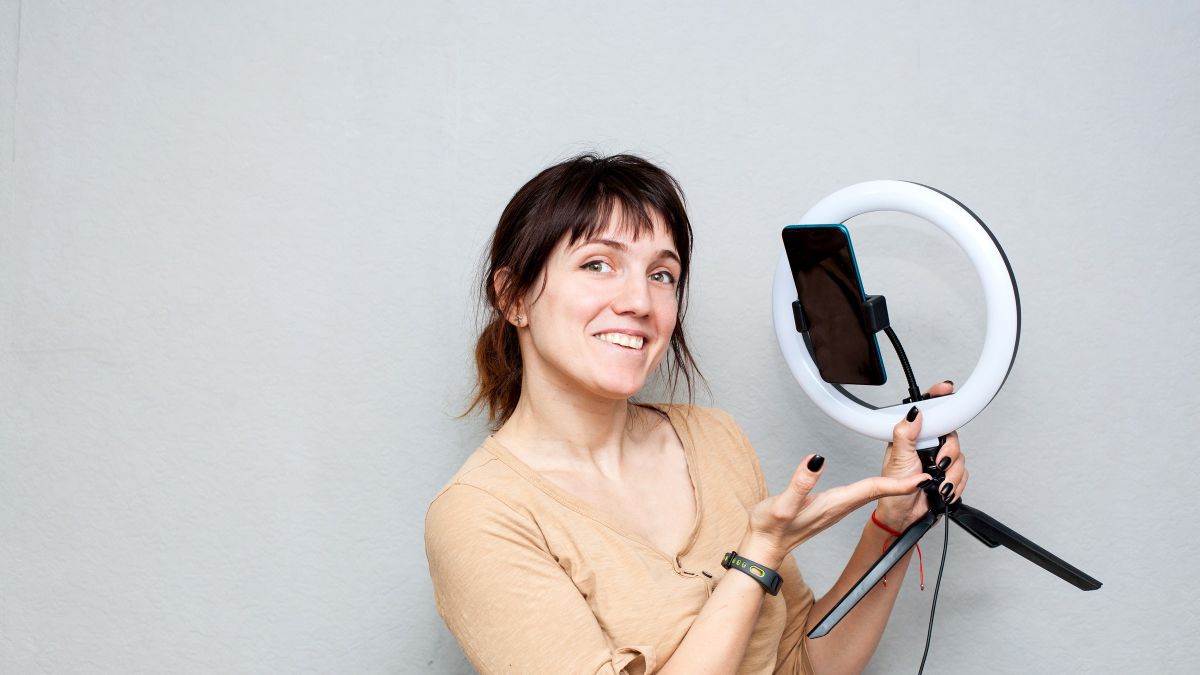
Three point lighting, with the lights at eye level. Two lights in front at roughly 45 degrees, plus a backlight to wash the shadow off the wall. Too high and you read younger; too low and you either light your shirt more than your face or cast shadows under the eyes that age you. Source.
A camera's built in microphone is the wrong shape for this. It picks up in every direction, so a reader one foot away drowns out the actor four feet away. A shotgun mic with its own battery is the fix; one without a battery hisses as the camera drains. Source.
Glasses that flash back at the lights: slide the arms up about an inch above the ear so the reflection angles downward, and hold them with tape or a bobby pin. Source.
Wardrobe
Suggest the character, do not costume it. A queen is a nice dress, not a gown and a crown. A police officer is a navy fitted shirt, not a rented uniform. Source.
A note from casting binds you; the script does not. A dress instruction from the casting director is an instruction, and ignoring it reads as disrespect before you have said a word. Wardrobe described in the script matters far less. Source.
Camera test it, and do not buy anything for a first round. What a mirror shows and what a lens shows differ in ways you cannot predict. Thirty seconds of footage settles it. Borrow the outfit, or spend on one cheap accessory; the money is better in classes or headshots. Source.
The slate
Stop looking for the one correct slate. Some casting directors care a great deal about it, others not at all, and nearly everyone has a slightly different idea of what it should be. Source.
Match it to the temperature of the scene. A bright, perfectly composed slate after you have played a mother learning her son is dead will pull the viewer straight out of the audition. Source.
Give the facts they asked for and nothing more, and if the slate is taking longer than the scene, you have loaded it with meaning it does not carry. Source.
Drop the dialect for the slate, but do not swing to your chattiest self either. Source. And rehearse it: it is the first thing they see. Source.
The performance, which is the part that actually decides it
What you do on the off lines exposes you. Plenty of actors do interesting work while they speak and go blank while listening to the reader. That is where auditions fall down, and a director needs reactions to cut to: the camera will not always be on you when you talk. Source.
Locking eyes with the reader is only half of it. Real conversations do not work that way. Roughly half the time goes on the other person and half on the floor, a clock, a sound outside the room. Vagueness about your surroundings is one of the most common failures in a tape, because the world of the scene exists only in your head and the camera picks it up only as far as you commit to it. Source.
If the breakdown asks for eyeline into the lens, do it, even though it feels wrong with your reader sitting off to the side. Source.
Editing and sending
Mark your keeper takes while the camera is still rolling. A thumbs up or a rock sign into the lens right after a good take means you find it instantly in the thumbnails instead of opening fifteen files. Source.
Trim the slate tight at both ends, cutting in just before the name and out on the smile, and put the clips in the order casting will watch them. Source.
When you compress, 3 Mbps is the floor. Below that the quality loss becomes visible; at around 5 Mbps the eye cannot tell the compressed file from the original. Source.
Get the room right and there is barely anything to edit. If the light and the sound are correct while you shoot, all that is left is trimming the front and the end. Source.
Two things worth knowing about the other end
A tape that goes unwatched usually has a reason that is nothing to do with you. Casting directors work through lunches, nights and weekends trying to watch everything they asked for. A script draft that rewrote the character, or a lost location forcing them to cast tomorrow from tapes already in hand, is a more common explanation than anything you did. Source.
Wanting it too much shows on camera. Desire to book is fine. Desperation is different, and it seeps into every moment of a read. Casting cannot read your mind, but they feel it, and it tends to get filed under the catch all note: not right for the part. Source.
Watch the sources
All of these come from Acting Craft, where the videos are searchable by what is actually said in them. Free, and nothing to sign up for.
Somewhere to put the tape
A reel on your own site is the one link you control. Build one free, or look at the designs that lead with video.
Every claim above is attributed to the video it came from and none of it is ours. Prices, measurements and settings are quoted as the speaker gave them and may have moved since. If we have summarized somebody badly, tell us and we will fix it.